Showing posts with label India. Show all posts

Monday, November 28, 2011

Hastinapur, the city of wisdom, in Argentina


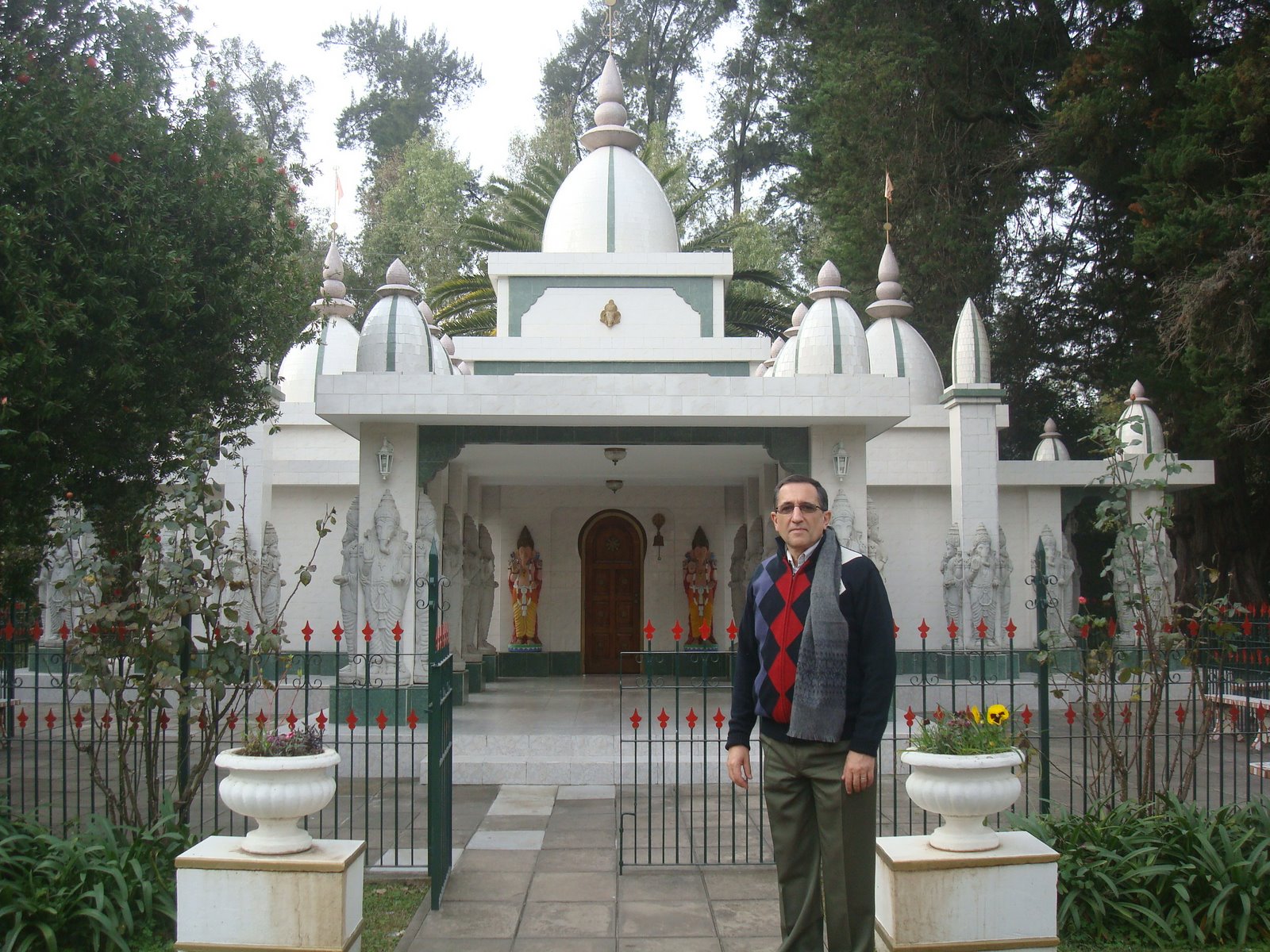
Hastinapur has a total area of twelve acres. Its population consists of a dozen Indian gods and an equal number of Argentine human beings. Some of the Indian gods reside in authentic temples filled with the scent of Indian agarbatties while others stay outdoor enjoying the fragrance of the flowers from the garden. Some are sitting or standing on the pedestals and others hang on the sides of walls and pillars. The gods who have their own temples include Ganesh, Krishna, Surya, Narayana and Siva. Since it is Hastinapur there is a temple for Pandavas too. Hastinapur is clearly a place fit for the gods ...who should be pleased with the cleanliness of the place, the serene surroundings and the green garden with Rosewood trees. The only noise comes from the hundreds of birds nesting in the trees. Then there is the soft music of the devotees who sing Bhajans. It is indeed a divine place which inspires sacred thoughts and holy spirit.
Ganesh is standing out in white against the greenery of the garden in the picture below.

The dozen Argentines who live there look after the gods and the place. During weekend, the human population increases to over one hundred. The Argentines do not go there seeking favours as many Indians do in Tirupathi. They go there for wisdom. This is why Hastinapur is called as the City of Wisdom (ciudad de la sabiduria). Saraswati, the Goddess of Learning blesses the students through the sculptures all around the compound. The Argentines learn philosophy, read in the library, practise yoga and meditation and sing Bhajans.

On the other side of the fence, there are cows grazing and occasionally staring at the Indian gods. The cows are relaxed and free from fear because they know that they will not become food at the dining table in Hastinapur, which is a vegetarian place. The inmates cook vegetarian food and share it with the children from poor families in the neighbourhood.
Hastinapur does not have any godmen seeking fame and fortune and flaunting wealthy followers. It is an instituition to pursue pure wisdom, peace and divinity. Neither in the city nor in the website names of those who run the place are given. The founders and directors of the Hastinapura Foundation do not seek publicity. They are humble but devoted people. They have their professions as company managers, engineers or professors. They volunteer their time and talents for the foundation.
Nor is Hastinapur the work of some overenthusiastic drum-beating Hare Krishna types or faith-lead Saibaba followers. Hastinapur respects all the religions and beliefs. Their ten temples include one for Buddha, one for Virgin Mary, one for the Greek god Demeter and another one called as the the Temple of All Faiths. Their library has books of all religions and schools of thought. Hastinapur seeks true wisdom, going beyond the boundaries of established religions. The City of Wisdom is not the ultimate destination. It does not prescribe wisdom doses. It simply helps people to seek, find and pursue their own path to wisdom. They give classes in yoga, meditation, philosophy, devotional singing and sacred drama. They organise workshops, seminars and retreats. They also provide community service. They celebrate festivals such as Ganesh Chathurthi and Baishaki. Their next project is to broadcast through radio.
Hastinapur temples do not have priests or other middlemen between the gods and worshippers. There is no money collection, like in Tirupathi. Worshippers pray, recite mantras and sing devotional songs individually or in groups.
Meditation Hall

Hastinapur has a post graduate course in yoga which takes three years to complete. The classes are held in the weekends only. There are 2500 students studying yoga and philosophy in the Hastinapur centres. The students are being taught by 100 teachers on philosophy and 120 teachers on yoga.


Many Argentines go to Hastinapur as a retreat from the hectic city of Buenos Aires which is just fifty kilometres away. They practise meditation in the quiet natural environment. They do yoga, read books from the library, discuss philosophy and join the singing of bhajans. Hastinapur is an authentic Ashram.

Hastinapur Foundation has published a number of books on Indian philosophy and translated Bhagwat Gita, Bhakti Sutras, Upanishads,Srimad Bhagwatam and Yoga Sutras. Their latest publication is Mahabharatha in Spanish. They have so far published three volumes and plan to do a total of twelve volumes in the coming years. Each volume is over 500 pages. The founder Alda Albrecht and other members of the Foundation have also written a number of books.

main entrance to the Hastinapur city


Hastinapura Foundation was established by Ada Albrecht in 1981. She introduced Indian philosophy and became a Guru for the Argentines seeking wisdom. She wrote a number of books such as ¨The Saints and teachings of India¨ and ¨The teachings of the monks from Himalayas¨.

Gustavo Canzobre was one of her students, who is now the Director of the Hastinapur college of professors. He was seventeen years old when he became interested in Indian wisdom. During the Third Festival of India organised by the embassy in Buenos Aires in November 2010, he gave a talk on the templearchitecture of South India. He has agreed to give a talk on Indian philosophy in the forthcoming Fourth Festival of India in December 2011. He is a manager in a local company for living and dedicates rest of his time to Hastinapura Foundation. He is knowledgeable about Indian vedas and upanishads and is going to India on his second visit in August this year.
Gustavo Canzobre in the picture below:
The architectural and scuplting work of the Hastinapur complex has been done entirely by Argentines. The architects and sculptors have studied Indian temples and have done their work professionally and aesthetically. Even now they are constructing some more buildings with Indian sculptures and statues.


Pillars of the entrance to Ganesh temple below:


The pond in front of the temple has fresh water and fish:
A small outdoor Ganesh temple in the garden


Hastinapura Foundation has sixteen centres in Buenos Aires and three more in the rest of Argentina. They have also established centres in Uruguay, Bolivia and Colombia. Information on the Foundation and its activities can be seen at their website


Lord Siva is sitting majestically in the large garden guarded by Ganesh on the four sides:
Latin Americans are, of course, known for fun and fiesta. At the same time, there are thousands of Latin Americans who take Mahabharatha and Meditation more seriously than many Indians....
--------------------------------------------


Originally Posted By:
R Viswanathan
Ambassador of India to Argentina, Uruguay and Paraguay

.......................Passionate About Latin America...........................
Twitter  @AmbViswanathan
Tel      5411-43934274 & 43933994  
Addrs:   Torre Madero, 19th Floor, Av Eduardo Madero,  942,   Buenos Aires- C 1106 ACW

Friday, August 26, 2011

The Jan Lokpal Bill


Everybody knows about the Anti-Corruption Movement going on in the country. Everyone is familiar with the term JAN LOKPAL BILL. But do we know what exactly is the Jan Lokpal Bill??? What difference will it make if it is passed??? Atleast I was unaware about it until I read this.

I received this on mail from Mr. Manish Desai. Thank You very much for sharing this valuable piece of information with me. And for all those who are still unaware of this, I am posting this. Read it and Circulate it among friends. Let the Country know for what they are fighting and how the Jan Lokpal can curb the Currupts.

Moreover I would also like to Thank Anna Hazare for taking an initiative to fight for this noble cause. I wish him a very good health too.


Existing System  
System Proposed by civil society
No politician or senior officer ever goes to jail despite huge evidence because Anti Corruption Branch (ACB) and CBI directly come under the government. Before starting investigation or initiating prosecution in any case, they have to take permission from the same bosses, against whom the case has to be investigated. 
 
Lokpal at centre and Lokayukta at state level will be independent bodies. ACB and CBI will be merged into these bodies. They will have power to initiate investigations and prosecution against any officer or politician without needing anyoneⳠpermission. Investigation should be completed within 1 year and trial to get over in next 1 year. Within two years, the corrupt should go to jail.
No corrupt officer is dismissed from the job because Central Vigilance Commission, which is supposed to dismiss corrupt officers, is only an advisory body. Whenever it advises government to dismiss any senior corrupt officer, its advice is never implemented. 
 
Lokpal and Lokayukta will have complete powers to order dismissal of a corrupt officer. CVC and all departmental vigilance will be merged into Lokpal and state vigilance will be merged into Lokayukta.
No action is taken against corrupt judges because permission is required from the Chief Justice of India to even register an FIR against corrupt judges. 
 
Lokpal & Lokayukta shall have powers to investigate and prosecute any judgewithout needing anyoneⳠpermission.
Nowhere to go - People expose corruption but no action is taken on their complaints. 
 
Lokpal & Lokayukta will have to enquire into and hear every complaint.
There is so much corruption within CBI and vigilance departments. Their functioning is so secret that it encourages corruption within these agencies.
All investigations in Lokpal & Lokayukta shall be transparent. After completion of investigation, all case records shall be open to public. Complaint against any staff of Lokpal & Lokayukta shall be enquired and punishment announced within two months. 
 
Weak and corrupt people are appointed as heads of anti-corruption agencies.
Politicians will have absolutely no say in selections of Chairperson and members of Lokpal & Lokayukta. Selections will take place through a transparent and public participatory process. 
 
Citizens face harassment in government offices. Sometimes they are forced to pay bribes. One can only complaint to senior officers. No action is taken on complaints because senior officers also get their cut.
Lokpal & Lokayukta will get public grievances resolved in time bound manner, impose a penalty of Rs 250 per day of delay to be deducted from the salary of guilty officer and award that amount as compensation to the aggrieved citizen. 
 
Nothing in law to recover ill gotten wealth. A corrupt person can come out of jail and enjoy that money.
Loss caused to the government due to corruption will be recovered from all accused.
Small punishment for corruption-Punishment for corruption is minimum 6 months and maximum 7 years.
Enhanced punishment - The punishment would be minimum 5 years and maximum of life imprisonment.


हम वतन के लिए॒ सिर कटाते रहे,   दर्द होता रहा छटपटाते रहे,
आईने॒ से सदा चोट खाते रहे,
वो वतन बेचकर मुस्कुराते रहे 


280 लाख करोड़ का सवाल है ...
भारतीय गरीब है लेकिन भारत देश कभी गरीब नहीं रहा"* ये कहना है स्विस बैंक के डाइरेक्टर का. स्विस बैंक के डाइरेक्टर ने यह भी कहा है कि भारत का लगभग 280 लाख करोड़ रुपये उनके स्विस बैंक में जमा है . ये रकम इतनी है कि भारत का आने वाले 30 सालों का बजट बिना टैक्स के बनाया जा सकता है.


या यूँ कहें कि 60 करोड़ रोजगार के अवसर दिए जा सकते है. या यूँ भी कह सकते है कि भारत के किसी भी गाँव से दिल्ली तक 4 लेन रोड बनाया जा सकता है. 


ऐसा भी कह सकते है कि 500 से ज्यादा सामाजिक प्रोजेक्ट पूर्ण किये जा सकते है. ये रकम इतनी ज्यादा है कि अगर हर भारतीय को 2000 रुपये हर महीने भी दिए जाये तो 60 साल तक ख़त्म ना हो. यानी भारत को किसी वर्ल्ड बैंक से लोन लेने कि कोई जरुरत नहीं है. जरा सोचिये ... हमारे भ्रष्ट राजनेताओं और नोकरशाहों ने कैसे देश को लूटा है और ये लूट का सिलसिला अभी तक जारी है. 


इस सिलसिले को अब रोकना बहुत ज्यादा जरूरी हो गया है. अंग्रेजो ने हमारे भारत पर करीब 200 सालो तक राज करके करीब 1 लाख करोड़ रुपये लूटा. 


मगर आजादी के केवल 64 सालों में हमारे भ्रस्टाचार ने 280 लाख करोड़ लूटा है. एक तरफ 200 साल में 1 लाख करोड़ है और दूसरी तरफ केवल 64 सालों में 280 लाख करोड़ है. यानि हर साल लगभग 4.37 लाख करोड़, या हर महीने करीब 36 हजार करोड़ भारतीय मुद्रा स्विस बैंक में इन भ्रष्ट लोगों द्वारा जमा करवाई गई है. 


हमे भ्रस्ट राजनेताओं और भ्रष्ट अधिकारीयों के खिलाफ जाने का पूर्ण अधिकार है. हाल ही में हुवे घोटालों का आप सभी को पता ही है - CWG घोटाला, २ जी स्पेक्ट्रुम घोटाला , आदर्श होउसिंग घोटाला... और ना जाने कौन कौन से घोटाले अभी उजागर होने वाले है........ 


आप लोग जोक्स फॉरवर्ड करते ही हो. 
इसे भी इतना फॉरवर्ड करो की पूरा भारत इसे पढ़े ... और एक आन्दोलन बन जाये 


Spread it like a Wild fire
Let The People Know this
Our Nation needs us 
Please Contribute 

Sunday, May 15, 2011

Petrol Price Hike


Some friends here feel that the petrol price hike was inevitable and its not linked to corruption - the truth is, it wasn't and it is! There are a few points one should ponder upon before jumping to quick conclusions:

1. Fuel prices in India are already much more than in many other countries due to a numbers of taxes and levies. Why doesn't the Govt consider lowering these taxes before allowing the hike in fuel prices?

2. Why is it that diesel is still being subsidised when several recommendations have been made to bring diesel prices at parity with that of petrol? Isn't it in effect, collecting the money from middle class in form of petrol price hike and bribing the farmers and SUV/MUV owners?

3. Delhi based industrialist Bharat Ram says, "There are mainly two large manufacturers who produce primarily diesel vehicles and, through the automobile associations, they have a strong lobby to keep status quot. Only one out of 10 vehicles was running on diesel "some years ago" . At present, there is a gap of Rs 20.62 a litre between the price of the two motor fuels in Delhi."http://articles.timesofindia.indiatimes.com/2011-05-10/india-business/29527886_1_petrol-and-diesel-litre-diesel-vehicles

4. There are lakhs if not millions of Govt vehicles plying on the roads, ferrying NETAS and BABUS. Who pays for the fuel in these vehicles? Why hasn't the Govt. considered moving to cleaner fuels like CNG? Their vehicles still run on precious petrol and diesel?

5. A lot of people say that hiking the price of petrol is beneficial for the environment. Have you ever asked the Govt. why urban mass transport systems (in most cities) are in complete disarray and inefficient? Do you feel people travel by own expensive transport out of choice? Why don't we have an efficient metro rail in all metro cities and efficient mass transport in other cities? Isn't this a deficiency in governance and complete disregard for the people?

6. We would not like to reveal the source but we have been told that the petrol prices are being hiked to bring the price to a level to make it profitable for private operators to enter the fray again, they quit the business few years back since they could not compete with the subsidized fuel sold by Govt owned companies!!! Not possible without greasing a few palms and really big ones for that matter!!!

7. Why is the Govt not taxing these private vehicles heavily and investing the money on efficient public transport systems? Instead what we get is, several new car launches every month, That is the only way to cut down the consumption of fossil fuels!!!

Mentioned here is Extract from Facebook Page India Against Corruption 
I would like to thank the author for sharing this thing

Also after reading this article, if you have something more to share, do it. Let the people be aware.
Contribute to the cause

Tuesday, March 29, 2011

Asha Aman Ki Aisi Taisi

This is an extract from Random Thoughts of a Demented Mind.
Visit the blog if you like this one and want something more on the Cricket. Also Follow it for its regular updates....!!!!!

The India-Pak Match on this Wednesday is gonna be a very exciting. The whole nation is looking forward for this match to be held on Wednesday 30th March, 2011 at the Mohali Stadium. I think this is something that all the cricket lovers will love to read. So move further, Read it... !!!!!!!
A game between them is not just about who scores more runs than the other. No sir, its about who puts the boot on whose throat and who first chokes on one’s own blood and phlegm

An India-Pakistan cricket game is just a game.
Cricket will be the winner at the end of it all.
Sports and politics should not mix.
The general public of Pakistan want nothing but friendly relations with India.
India and Pakistan would be bhai-bhai had it not been for evil politicians.
Pakistan is as much  a victim of terror as India.
Tensions between the two countries can be solved by people-to-people interactions.
Now that we have got the politically correct guano out of the way, let’s talk some real shit, shall we?

Come Wednesday, it’s IT.
The India-Pakistan rivalry is like no other in modern sport namely because these are the only countries which spill each other’s blood regularly (One side spills more blood than the other but you already knew that didnt you?). A game between them is not just about who scores more runs than the other. No sir, its about who puts the boot on whose throat and who first chokes on one’s own blood and phlegm. Its about national humiliation. I know that should not be it. Neither should Kasab be the official guest of the country. But that is the truth. So come to terms with it. And leave the bullcrap at the door.

The first salvo in this battle was sent by our Main Man Singh sending an invitation of fransip to Pakistani PM Gilani and Pakistan Ten-Per-Cent-In-Chief Zardari, just as Zardari tells Kerry that “India helped Mumbai attacks” [Link] It’s such Tohfa Kabool Ho moments from our Main Man that brings tears to the eyes of some of us and brings cries of orgasmic euphoria from the Asha Aman men and women.
A country sends their trained army over to our borders to kill innocent people, makes heroes out of the perpetrators, blames India for this dastardly attack and we react by inviting these fine men, who funded the attack and provide cover for the attackers, over to our country to enjoy our hospitality.  It would make better sense to clone 10 copies of Ravindra Jadeja and make that the Indian cricket team. Or perhaps the master plan is to keep the entire Pakistani top-brass in the stadium so that the LET (the only India-facing terror group that has never targeted the Pakistani government) stays away—after all who wants to shoot the hand that finally signs the cheque?
So now we know that Gilani is  coming. And as gracious hosts, we need to take care of security. Not just their security but security from them. For instance, if you are a woman you definitely need to be protected from Gilani in a crowd. [Video...moderately NSFW] since he is very much “Chance pe dance maar le” types.
As for Zardari (should he come ), we need to make sure he pays for his female “tour guides” (or more precisely tour escorts) unlike what he did in Turkey.
We also need to make sure that Shahid Afridi is not made unhappy—-in a press conference Afridi has said that the Indian media has been writing negative things about his team like  raising questions about Afridi’s age, enquiring whether Misbah ul Haq, a Physics graduate from Pakistan, knows Newton’s Third Law of Motion (He would be forgiven for not knowing that “For every action, there is an equal and opposite reaction” since he lives as a neighbor of India), investigating whether this actually is Kamran Akmal after a good day of sponsored catch-dropping and whether it is true that every Pakistani cricketer is made to repeat “I shall not point my bat at Venkatesh Prasad” hundred times before every World Cup match against India. Because if Afridi is not happy, he may bring out his Boom Boom. And we do not want that.

On the field, the first burning question is whether Shoaib Akthar will play. I think he should. As purely a cricketing decision, it makes sense for him to play because this will be his last match. Akthar is a big-match showboat player and he will definitely give it his-all (the main problem through his career has been that once selected, he would go “off mood” and refuse to complete his quota citing injury). Against India for the final time and on such a big stage and in front of a partisan Indian crowd, he will truly bleed green, drawing oxygen from every last bit of organic growth from his nether regions. That is guaranteed. As an Indian fan, I want him to play because he is one of the last of the vanishing breed of Pakistani cricket players one loved to hate, supremely talented larger-than-life swinging dicks who played their best when cornered (the only other left is Afridi) and nothing would give me more pleasure than to see him thumped by our cricketers in his last match.
The second question is India’s bowling attack. Will the Mohali pitch support pace? (I hope it does not for India’s sake since our game plan relies vitally on using Yuvi as a fifth bowler). And will the Cochi Cockatoo play in place of Mild Munaf or will India’s last over specialist Nehra come back into the side? I know there is a lot of support for Josh-e-Junoon Sreesanth and if the pitch is a fast one he should indeed get the nod. I am just afraid that his overt aggression does not mess things up like it did for Zaheer in 2003. Here is the deal. Sreesanth’s aggro is a put-on act, it is not genuine badassness (like Akthar, Afridi, Miandad, Anwar, Imran, and on Indian side in the current side Gambhir) and one tight slap, in reality or figuratively, brings out his weepy self. He started off well against Bangladesh, did not have luck going for him and then totally fell away. This is exactly what makes him so iffy against Pakistan because the pressure will be extreme. If he could not handle an assault by Iqbal and Junaid and the rest, I shudder to think of how he would come back against a shellacking from the Pakistani batsmen whose bats will be flying from the get-go. In this respect, Munaf is the cooler head  and against Pakistan keeping the ball near the stumps is a big plus, rather than exaggerated swing.
But everything, the politics and the mind-games, will become redundant once the skippers come out for the toss. Yes even Shastri and the original Pakistani murgi Aamir Sohail’s shadow sparring over who has the better hair job will no longer be relevant [Video]
Two counties will hold their breath. The universe shall shake with sound.
War will begin.
And there will be pain. Yes sir. There will be pain.

Tuesday, February 22, 2011

Creating Maps of Inequalities


Strange looking map, isn't it? Well, it's just a
modified map, a population cartogram, where the land area is shown in
proportion to population. Except that this is an inequality map. Here,
researchers have taken together data showing how many people suffer from a
certain disease in a certain land area, and then represent the map
proportionately.

This particular figure shows early neonatal
mortality, the deaths of infants in their first week after birth. India has the
highest neonatal mortality rate in the world (along with Pakistan, Bangladesh
and other countries of the subcontinent).

Pretty sad, isn't it?

Like the author says; "You
can say it, you can prove it, you can tabulate it, but it is only when you show
it that it hits home"
Statistics are hard to remember. Facts are
easily forgotten. But pictures remain in the mind for a long time.

There are fascinating, and sometimes surprising
insights from the six test examples; public spending on health, private
spending on health, neonatal mortality, HIV/AIDS prevalance, and the prevalance
of malaria.

To me, it was also depressing to be reminded how
badly India scored on all of these. These are just raw numbers from the United
Nations Human Development report, taken and plotted.

The explosive development in India is wonderful
and welcome, but mostly meaningless if the basic indicators of human life
remain depressing.